

Mental Health & Substance Use Resources & referrals
Mental Health & Substance Use
UNCG offers a wide range of on-line and in-person education, training and mental health & substance use resources and referrals designed to support students’ mental health, well-being and academic success!
Welltrack
WellTrack is free to all enrolled UNCG students. WellTrack is an online self-directed therapy experience for managing depression and anxiety. It is also a self-help tool used in combination with counseling.
Togetherall
UNC Greensboro students can access free online mental health support with Togetherall, any time, any day. Whether you’re struggling to cope, feeling low or just need a place to talk, Togetherall can help you to explore your feelings in a safe supportive environment.
Check out additional Peer Support offerings @ Spartan Well-Being.
Spartan Recovery@UNCG offers Peer Support for Students in Recovery from Alcohol and/or other Drugs.
Brief mental health screenings are the quickest way to determine if you or someone you care about should connect with a behavioral health professional. Think of these as a checkup from your neck up. These screenings are anonymous and confidential and immediately following the brief questionnaire you will see your results, recommendations, and key resources.
Anonymous On-Line Screening: CCAPS-Screen
For more free mental health screenings, y en Español, visit Mental Health America
Get Connected to off-campus care
If you need services outside of Counseling & Psychological Services, we make it easier for you.
The UNCG CAPS offers a referral database of community mental health providers through MiResource. Each provider was invited by Counseling & Psychological Services to join the directory. This directory is available to anyone looking for mental health care in their community. Access MiResource: your guide to mental health care resources
Some students may need to seek specialized services outside of UNCG. Psychology Today is an online resource for finding therapists by city or zip code throughout the United States. Use this resource to find a therapist or treatment program off-campus.
Common Reasons for seeking off-campus care include:
- Wanting longer-term treatment or specialized services
- Preferring an off-campus provider
- Ineligibility to receive Counseling & Psychological Services
Examples of needing an off-campus referral:
- Request for formal psychological assessment (e.g. ADHD or psychoeducational evaluations)
- Request for services to fulfill court-mandated assessment or treatment requirements
- Desire or need to be seen weekly or more than once a week
- Desire or need for ongoing long-term therapy
BASICS stands for Brief Alcohol Screening and Intervention for College Students. CASICS stands for Cannabis Screening and Intervention for College Students.
These programs are offered for all UNCG students who may want to explore their alcohol and drug use, but the goal of the program is to reduce risky behaviors and harmful consequences of alcohol or cannabis abuse. Contact Us: basics@uncg.edu
BASICS and CASICS are NOT “Just Say No” or abstinence-only. They are designed to assist students in examining their own choices in a judgment-free environment. The BASICS/CASICS facilitator* will provide objective feedback, based on an interview and questionnaires filled out by the student, to encourage positive changes in behavior. Essentially, BASICS/CASICS will provide the information and guidance, but what a student chooses to do is entirely up to them.
Who can join BASICS/CASICS?
Some students attend BASICS/CASICS to fulfill a university sanction or court order because of an alcohol or cannabis related offense, while others come because they have concerns about their alcohol or cannabis use. BASICS/CASICS is appropriate for anyone who uses alcohol or cannabis and is concerned about their use.
If a student chooses to participate in BASICS/CASICS to complete a university or court ordered requirement, we can provide documentation of program completion if a student signs a release of information form. We will not release any assessment results or personal information shared during the BASICS/CASICS appointment.
UNCG has a robust Drug and Alcohol Prevention Program for faculty, staff and students.
Spartan Recovery supports students in recovery from.
Are you a person in recovery from alcohol or other drugs? Do you participate in programs related to recovery?
Spartan Recovery at UNCG is the premier program in the state of North Carolina for students who have made improvements to their lives by not drinking alcohol or using other illicit or non-prescribed drugs. Visit our page.
Opioids are a class of drugs that include heroin, synthetic opioids such as fentanyl, and prescription pain relievers (see below). All opioids are chemically related and interact with opioid receptors on nerve cells in the body and brain. Opioid pain relievers are generally safe when taken for a short time and as prescribed by a doctor, but because they produce euphoria in addiction to pain relief, they can be misused.
What are the signs of opioid misuse and opioid use disorder?
Opioid misuse is the use prescription drugs without a prescription, or in a different way than prescribed. Opioid use disorder is a problematic pattern of opioid use that causes significant impairments or distress at work, school, or home.
Example of Opioids:
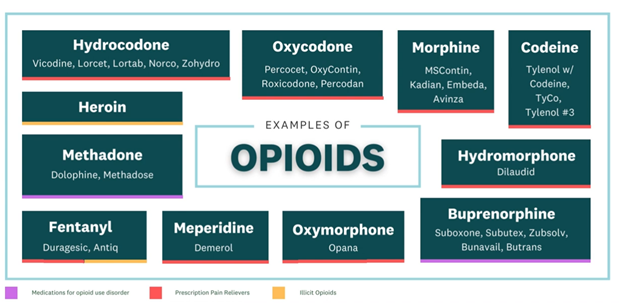
Common Signs of Opioid Intoxication:
- Drooping eyelids
- Constricted pupils
- Reduced respiratory rate
- Scratching (due to histamine release)
- Head nodding
Common Signs of Opioid Withdrawal:
| Objective Opioid Withdrawal Scale | Subjective Opioid Withdrawal Scale | Clinical Opioid Withdrawal Scale |
|---|---|---|
| Yawning Runny nose Goose bumps (observe arm) Sweating Shedding or secretion of tears Tremor (hands) Fixed (dilated) pupil Hot and cold flushes Restlessness Vomiting Muscles twitches Abdominal cramps Anxiety | I feel anxious I feel like yawning I’m perspiring My eyes are tearing My nose is running I have goose flesh I am shaking I have hot flashes I have cold flashes My bones and muscles ache I feel restless I feel nauseous I feel like vomiting My muscles twitch I have cramps in my stomach I feel like shooting up now | Pulse Sweating Restlessness Pupil size Bone or joint aches Runny nose Tearing GI upset Tremor of outstretched hands Yawning Anxiety or irritability Gooseflesh skin |
Learn more about Opioids: https://youtu.be/QKvjI66f094
Key Factors You Need to Know
- Naloxone Access Map: On Campus & Off Campus
- Signs of and Opioids Overdose
- 5 minutes Opioid Overdose Response Training: You will learn how to use Narcan Nasal Spray and you can get credit for your Co-Curricular Transcript! (add link to Spartan Connect and the training here)
- North Carolina’s Good Samaritan Law- that may protect a person who is overdosing on the person who called for help from legal trouble.
- UNCG Campus – Click here for more details; Student Code of Conduct Under the Section 7: Medical Amnesty Protocol (student handbook)
counseling & psychological services
ADDRESS:
2nd Floor, Gove Student Health Services
107 Gray Drive, Greensboro, NC 27412
PHONE: 336.334.5874
quick links
social media

@uncg_counselingservices